TEST - Canada Visit Visa & Work Permit (LMIA-based): What You Should Know (2025)
What is a work permit + LMIA and how is it different from a visitor visa
-
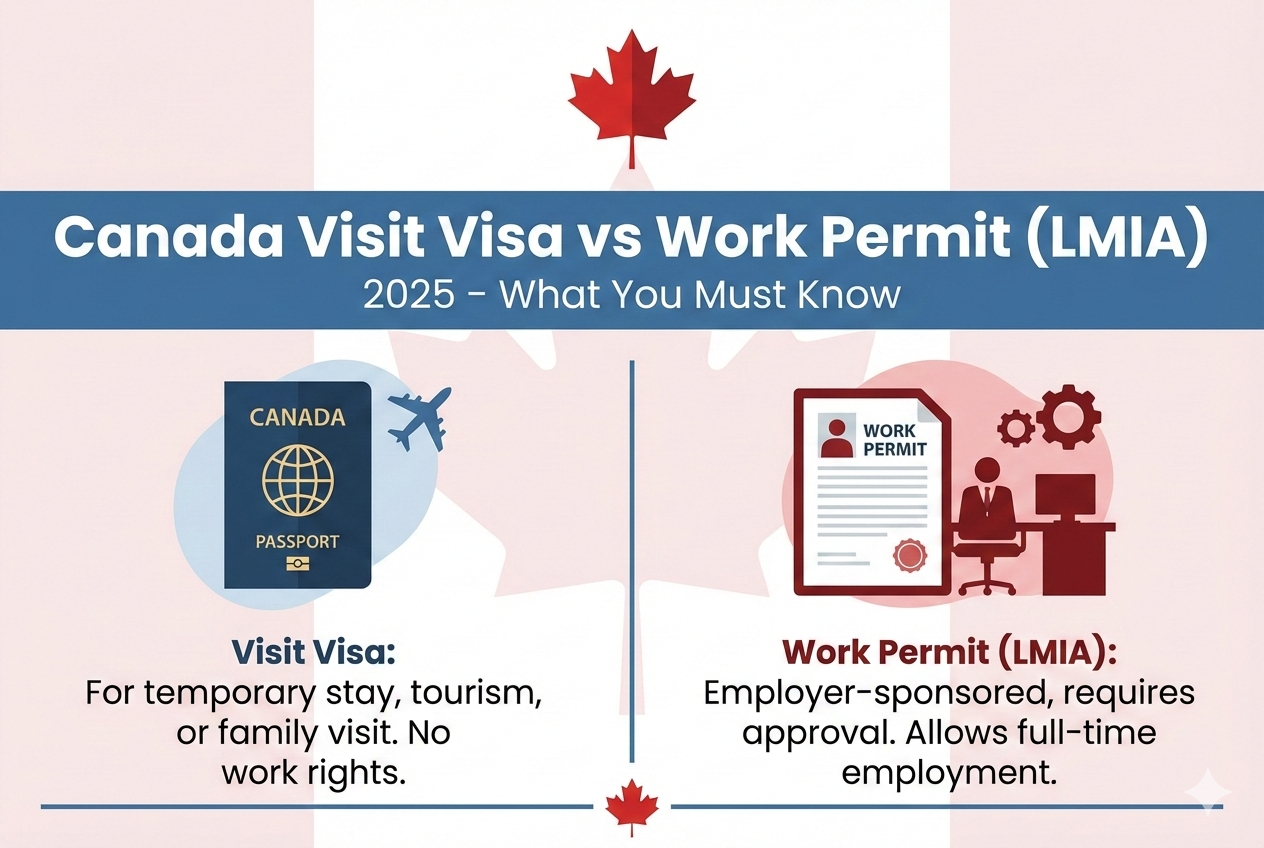
A visitor visa (or “temporary resident visa / applicant as visitor”) allows non-Canadians to enter Canada temporarily — typically for tourism, visiting family/friends, short stays.
-
A work permit is a separate permission you need if you want to work in Canada legally. If you are not a Canadian citizen or permanent resident, and you want to work — you need a work permit.
-
Often, to get a “temporary (employer-specific) work permit,” your prospective employer must first get a Labour Market Impact Assessment (LMIA) from Employment and Social Development Canada (ESDC). The LMIA shows that there is a genuine need for a foreign worker and no qualified Canadian is available.
-
Once employer has a positive LMIA, they give you a job offer and the LMIA letter — with that you apply for a work permit.
Thus — visitor visa and work permit are separate. Having a visitor visa doesn’t automatically allow you to work.
Recent changes & current reality (2024–2025)
Here’s a summary of what’s new and what to watch out for if you are considering the route now:
| Change / Update | What it means / Key takeaway |
|---|---|
| End of COVID-era “in-Canada visitor → work permit” policy | For a while during COVID, visitors in Canada with a valid job offer + LMIA (or LMIA-exempt offer) could apply for a work permit from within Canada. That temporary policy was formally revoked around August 2024. |
| Now — if you apply from India (or outside Canada), follow standard process | Most applicants must apply for work permit outside Canada. That means — get job + positive LMIA, then apply for permit via visa office abroad (e.g. from India). |
| Employer-compliance scrutiny is stronger | When employer applies for LMIA (to hire a foreign worker), IRCC / ESDC examine whether job offer is genuine, working conditions, wages, compliance history, etc. Employers who have violated terms may be banned from hiring foreign workers. |
| Documentation required on arrival | If your work permit is approved, at port of entry you’ll need passport, visitor visa (if needed), letter of introduction/POE letter, job offer + employer’s positive LMIA, proof of your credentials (education/experience). |
| Tighter immigration quotas and fewer temporary visas in coming years (2026-28) | According to recent immigration-level plan, Canada intends to reduce the number of temporary residents — including work-permit holders — over 2026-28. |
Bottom line (2025): If you plan to go from India (or another country) to Canada for a job, you’ll most likely need to follow the standard LMIA-based work permit route — get job + employer obtains LMIA → apply from outside Canada. The easier “visitor → work permit” route is no longer reliably available.
Step-by-step: How to apply for LMIA-based work permit (from abroad)
-
Find a legitimate Canadian employer who is willing to hire you and apply for LMIA.
-
Employer should submit LMIA application to ESDC, demonstrating need for foreign worker and compliance.
-
Once employer gets positive LMIA letter — employer sends job offer + LMIA copy to you.
-
You (the applicant) prepare documentation: passport, job offer, LMIA letter; credentials (education/experience); police clearance (if required); medical exam (if required).
-
Apply for work permit via visa office (since applying from outside Canada). Fill relevant forms, upload documents, pay fees, provide biometrics (if required).
-
Once approved — you get a “port of entry letter of introduction” (POE). When you travel to Canada you need to show passport + POE + job offer + LMIA copy at border.
Why many people hope for “visit visa → work permit inside Canada” (but it’s less realistic now)
-
During COVID times, there was a temporary policy under which visitors in Canada with valid job offer + LMIA (or LMIA-exempt offer) could apply for work permit without leaving the country.
-
That policy was convenient — saved time, allowed applicants already in Canada to switch status. But as of late 2024, that temporary policy has ended for most.
-
As a result, many people who expected to convert their visitor status to “work permit holder” no longer have that straightforward option — they must return to home country and apply from there.
What Indians (or international applicants from outside Canada) need to be especially careful about
-
Ensure employer is legitimate and willing to go through LMIA: Because employer compliance is strictly checked. If employer is on “ineligible employers list”, permit will be rejected.
-
Documents and credentials must be genuine — job offer, experience/education proof, possibly police clearance, maybe medical exam (depending on job and stay length) — any mismatch or missing docs may cause refusal.
-
Do not rely on outdated/expired “visitor → work permit inside Canada” paths — these have been largely rescinded. If you enter Canada on a visitor visa expecting to convert status inside, you may face refusal.
-
Prepare for potentially tighter immigration environment and competition — because Canada’s immigration plan 2026–28 aims at reducing temporary resident numbers.
Conclusion & Advice
For someone in India (or outside Canada) considering going to Canada to work — the safest, most standard route in 2025 is secure a job + employer obtains LMIA → apply from home country for a temporary work permit. The “visitor visa → work permit” route that some people hoped for is no longer reliably available.
If you take this route — make sure your employer is eligible, paperwork is genuine, and you apply thoroughly. Also be mindful that immigration quotas are changing, so competition may increase.